








Choosing the right plant-based protein means looking far beyond the number of grams displayed on the bag.
A protein powder can proudly display “20 g of protein” on its packaging and yet not offer the same nutritional quality as another. To make a good choice, you need to look further than the number of grams: what proteins are used, what is their amino acid profile, how are they digested, and what else has been added?
What is protein for?
Proteins are essential. Our bodies use them, in particular, to build and renew muscles and many tissues, and to produce enzymes, hormones, and other essential molecules.
A protein itself is made up of small units: amino acids.
Among them, nine are called essential because our bodies cannot produce them in sufficient quantities. We must therefore obtain them through our diet.
Are you getting enough protein every day? Discover why protein is essential for your body to function at its best.
This is where the choice of a plant-based protein becomes interesting.
Amino acid profile: what you really need to look at
Some plant sources are naturally less rich in one or more essential amino acids. This does not mean that plant proteins are bad proteins: it simply means that you have to choose them carefully and, sometimes, combine them intelligently.
By associating different complementary plant sources, you can obtain a complete and balanced amino acid profile.
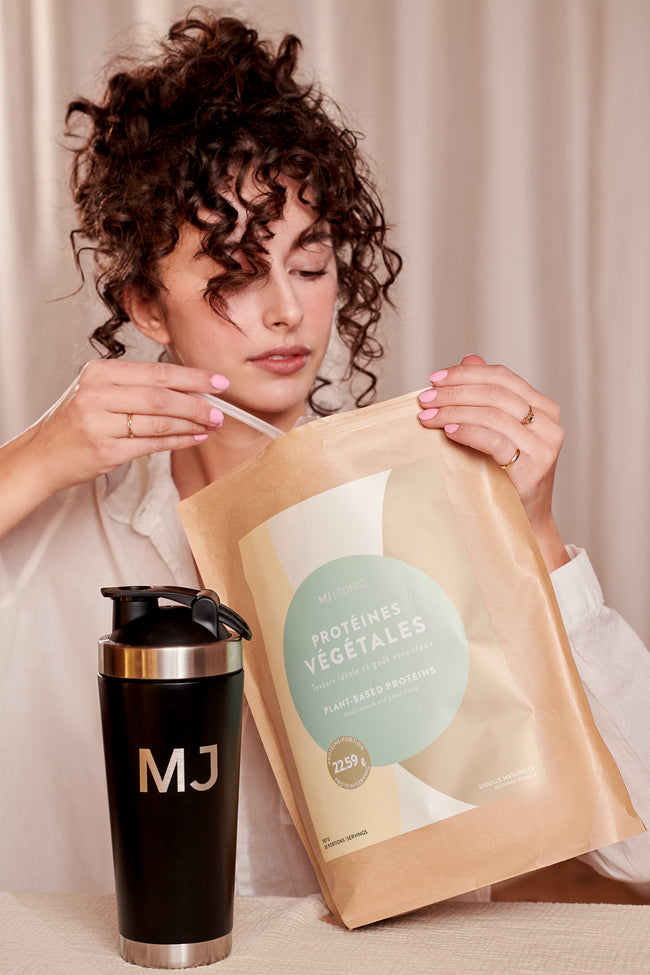
This is precisely what we are looking for at Maison Jacynthe: a plant-based protein that provides all essential amino acids in a carefully crafted profile, rather than a powder chosen solely to display a high protein number.
What about digestibility?
This is the other big question.
What we eat must be digestible, and the amino acids must be absorbable and usable by the body.
The quality of raw materials, their processing, and the balance of the formula therefore count enormously. A protein that feels heavy, causes bloating, or that you simply don't like to drink is also likely to stay at the back of the cupboard.
A good protein should be easy to incorporate into daily life.
More ingredients does not mean a better formula
When we develop a product, our question is always the same: does this ingredient have a reason to be there?
A protein powder does not need a long list of fillers, added sugar, or a succession of ingredients that only serve to transform its texture or appearance.
We prefer to focus on the essentials.
Carefully selected plant-based proteins.
A complete and balanced amino acid profile.
A digestible formula.
Sugar-free.
And nothing unnecessary.
Because a good formula is not the one with the most ingredients, but rather the one where everything has a reason for being.
How to recognize a good plant-based protein?
Turn the container over and really look at what's inside.
Ask yourself:
- How much protein does one serving provide?
- What are the protein sources?
- Is the profile of the nine essential amino acids complete?
- Is the formula easy to digest?
- Does it contain added sugar?
- Is the ingredient list unnecessarily long?
- Is this a formula I will actually want to take regularly?
This is exactly the reading we would like to see become a reflex.
Don't just choose your proteins for the number written on the front of the bag. Choose them for everything that is — and everything that isn't — behind it.