









Acne often makes you want to do more: cleanse harder, exfoliate, dry out, deep cleanse. However, acne-prone skin is not skin that should be stripped. On the contrary, it is skin whose barrier must be respected, irritation limited, and balance delicately supported.
Over the years, we have seen hundreds of people at Maison Jacynthe arrive with very congested, inflamed skin, sometimes marked by severe acne. And we have observed how an extremely simple, gentle, and consistent ritual could transform the appearance and comfort of certain skin types.
However, it is important to distinguish between cosmetic care and treatment: moderate to severe, painful, cystic, or scar-leaving acne deserves a medical or dermatological consultation.
1. Do not assault acne-prone skin
Skin with pimples, redness, and blackheads can be particularly vulnerable to irritation.
Highly detergent cleansers, repeated exfoliation, abrasive scrubs, and the accumulation of active ingredients can weaken the skin barrier and accentuate redness, discomfort, and inflammation.
The goal is therefore not to "make the oil disappear" at all costs, but to cleanse effectively without stripping.
2. Cleansing oil: yes, even on oily skin
It may seem counterintuitive: put oil on skin that already produces a lot of sebum?
However, a well-formulated cleansing oil can dissolve makeup, sunscreen, sebum, and fat-soluble impurities while avoiding the drying effect of some more aggressive cleansers.
At Maison Jacynthe, we favor massage: a few moments to gently work the oil into the skin, then carefully remove it.
The gesture is as important as the product: no excessive friction, no stripping, no war against the skin.
3. The ritual we favor
Our approach is deliberately minimalist:
Cleansing oil massage → rinse → Orange Blossom Water → Plump → a few drops of cleansing oil as a finishing touch.
Jojoba (included in the Cleansing Oil) plays a particularly interesting role in our skincare. Its particular composition, rich in wax esters, is closer to human sebum than many conventional vegetable oils. It thus offers a particularly interesting texture to support skin seeking its balance.
And most importantly, we give the skin time.
When it is very reactive, constantly multiplying products and new items can make it difficult to know what it truly tolerates.
4. "Letting the skin breathe": what does that really mean?
We often hear that a cosmetic must let the skin "breathe." Technically, the skin does not breathe like the lungs and does not need to eliminate toxins through its pores.
What we are looking for with acne-prone skin are well-tolerated formulas that do not unnecessarily burden the routine and do not promote follicular obstruction.
The important word is therefore less breathe than respect.
5. What about foundation?
This is a point we tend to overlook.
When you want to camouflage pimples and redness, the temptation is great to use thick layers of highly covering products. However, acne-prone skin generally benefits from makeup chosen with as much care as its skincare products.
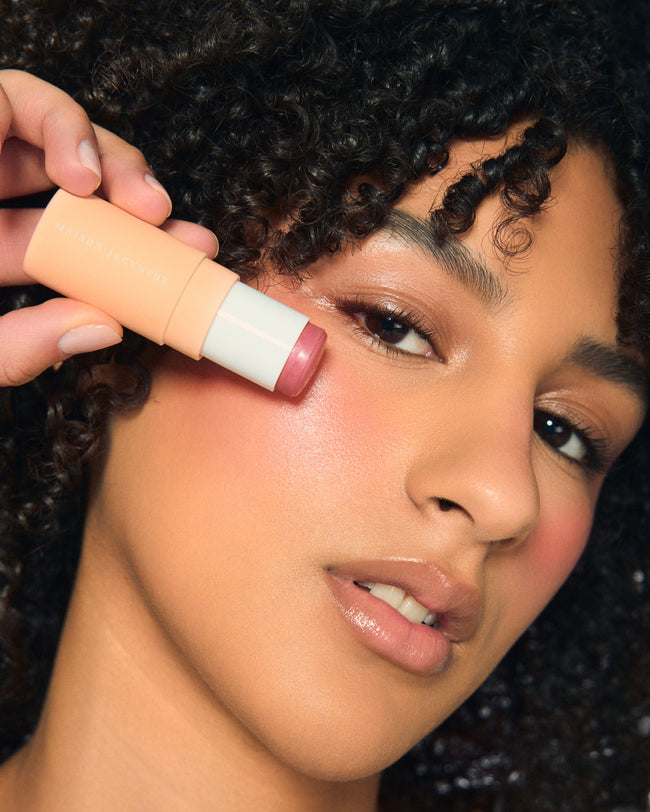
Our Radiance Tint was designed with this philosophy in mind: to beautifully unify and camouflage while integrating into a true beauty ritual.
We have seen some clients notice a significant improvement in the appearance of their skin after simply reviewing their makeup routine. These are individual experiences - not proof that a foundation treats acne - but they remind us how everything we apply daily deserves our attention.
6. When cosmetics are not enough
Acne is multifactorial. Sebum production, follicular obstruction, inflammation, Cutibacterium acnes, and hormonal influences can all play a role.
And the skin obviously does not live independently of the rest of the body.
Diet is a particularly interesting avenue. Scientific data suggests that a high glycemic load diet can worsen acne in some people. Dairy products - particularly certain types of milk - are also being researched, but the link is more complex and does not justify systematically eliminating them.
This is where we can go much further: blood sugar and acne, diet, zinc, omega-3, vitamin D, and other nutrients to consider as needed.
In summary
For acne-prone skin, stronger is not necessarily better.
Cleanse gently.
Respect the skin barrier.
Simplify the ritual.
Carefully choose what you apply daily.
Avoid multiplying aggressions.
And also look, when necessary, at what is happening internally.
A much more benevolent approach to skin that has too often been fought against.