













WARNING: IF SYMPTOMS WORSEN, PERSIST, OR APPEAR SERIOUS, PLEASE CONSULT YOUR DOCTOR.

Tea Tree NPN 80095322
Melaleuca alternifolia
The many healing properties of the oil distilled from the twigs and pointed leaves of this Australian tree are the subject of significant medical research. It is a traditional remedy used by Australian Aborigines to treat infected wounds.
History: The tea tree was discovered in Australia by naturalists accompanying Captain Cook on his second voyage on the Endeavour (1772-1775). Its leaves replaced the tea that the great navigator's crew was said to have sorely lacked. Another version has it that an Australian lake cured the sick who bathed there because it was surrounded by beneficial trees whose leaves fell into its water and infused in the bright sunshine. The healing properties exploited by the Aborigines were so evident that soldiers of the Australian Expeditionary Force during the Second World War added the tea tree to their field pharmacy.
Some recipe ideas:
Buttons:
Eucalyptus radiata NPN 80095317
Eucalyptus radiata
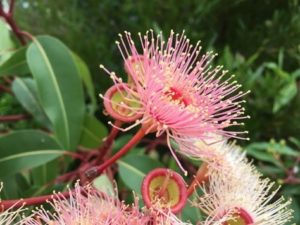
Its bark has the particularity of spontaneously detaching itself from the trunk in long ribbons, and its narrow and long green leaves were used in the fresh state by the Australian Aborigines to dress wounds and keep mosquitoes away. Slightly milder than Eucalyptus globulus essential oil, it is all the more accessible, especially for children who will be able to benefit from its most remarkable expectorant and decongestant respiratory effects. In diffusion, it acts favorably on tired individuals, prey to fixations or inner agitation.
History: Eucalyptus is a tree that can reach 50 meters in height. It is native to Tasmania in Australia, but its therapeutic use knows no bounds. Highly prized in Europe, its use is also widespread in the United States, Asia, and the far reaches of Africa. In German hospitals, eucalyptus is applied to the body via soaked compresses. Among the Zulu tribes, for example, healers use eucalyptus to treat coughs and asthma. In Asia, where the traditional use of medicinal plants is still very present, eucalyptus represents a very accessible medicine both in terms of supply and price.
Some recipe ideas:
Breathing:
For local application: On the temples and sinuses, diluted 20% in a vegetable oil, alone or in combination with mucolytic and pain-relieving essential oils, such as peppermint or verbenone rosemary.
Caution: Do not apply to eyes,
In inhalation:
5 drops in a bowl of steaming water, in the absence of fever, for 1 to 10 minutes, inhale the hot vapors deeply while sitting. Close your eyes. Do not go outside for 30 minutes after inhalation.
Cough :
Orally: 1 drop of eucalyptus radiata essential oil + 1 drop of lemon essence in honey, to be allowed to melt in the mouth 3 times a day.
Sanitation Fresh atmosphere:
Diffusion: 8 to 15 drops of a mixture of equal parts of eucalyptus radiata, spearmint and black spruce essential oils.
Note: These properties, benefits and methods of use are provided for informational purposes only; they should not in any way constitute or replace medical information that can only be provided by health professionals. For any use of essential oils for therapeutic purposes, please consult a doctor.
Extraction method
Steam distillation of leaves and twigs
Chemical components
Monoterpenes: pinene, myrcene
Monoterpenols: linalool, borneol, isoterpineol, geraniol terpineol
Monoterpenals: myrtenal, citronellal, geranial, neral
Terp. oxide: cineole, unepoxycyclomonoterpene, caryophyllene oxide
Aroma
Pure, crisp, and sharp. The oil has a powerful, distinctive eucalyptus (slightly camphorated) scent, with a sweeter note that clears the sinuses.
Mixtures
Bergamot, lemon, juniper, lavender, lemongrass, lemon balm, lemongrass, Scots pine, rosemary.
Properties
Anti-infectious, antibacterial, antiviral.
Anti-inflammatory
Anticatarrhal, expectorant
Analgesic, antineuralgic, antiphylogistic, antirheumatic, antiseptic, antispasmodic, balsamic, cicatrizing, depurative, diuretic, expectorant, febrifuge, hypoglycemic, insecticide, parasiticide, prophylactic, rubefacient, stimulant, vermifuge, vulnerary
Contraindications
None known at physiological doses.
Excerpts from the book “Aromatherapy – exactly”, P. Franchomme (aroma researcher), R. Jollois, in collaboration with J. Mars (physicist), D. Pénoel (Doctor of medicine). Edition Roger Jollois. Page 353, Excerpts from the book “Eucalyptus radiata Sieb. Ex DC. Ssp. Radiata cineolifera. Eucalyptus officinal (leaves) Myrtaceae ”.

Cinnamon NPN 80096911
Cinnamomum verum
Cinnamon is one of the oldest known spices, referenced in ancient Chinese, Sanskrit, and Egyptian writings, as well as in the Old Testament and the Torah. Cinnamon traveled the Silk and Spice Route from Asia to Mesopotamia, and then to the great cities of ancient Greece and Rome. The leaves of the cinnamon tree yield a spicy, clove-like essential oil known for its purifying properties. Its name comes from "canna," the Latin for "reed," and refers to its rounded shape, obtained from the bark of cinnamon tree branches, which curls up as they dry.
History: Since the beginning of the 3rd millennium BC, it has been used in China for its medicinal properties. Cinnamon was already known in Antiquity, although it is not really known where it came from. It was considered as precious as gold and used for its medicinal properties, as a digestive, a fortifier, but also as a spice to flavor wine. In Egypt, it was used in the process of embalming bodies, but also in the making of perfumes and holy oil. It is even said that Cleopatra used it willingly to bewitch her suitors.
Some recipe ideas:
Air purification:
In atmospheric diffusion with other milder oils: 10 drops of cinnamon essential oil + 10 drops of sweet orange essential oil + 7 drops of lemongrass essential oil.
Soothing, digestive comfort:
Mix into your oily preparation. Apply your mixture locally by massaging or rubbing on the stomach and abdomen twice a day:
30 ml of vegetable oil + 5 drops of cinnamon essential oil.
Cough:
Orally: Add 1 drop of cinnamon essential oil to a teaspoon of honey and mix with your favorite tea (3 times a day for internal treatment).
Pour 3 drops of the formula with a teaspoon of honey and add the mixture to a glass of hot (not boiling) water.
Prepare in advance, in a small amber dropper bottle: 2 1/2 ml
50 drops of lemon essential oil
12 drops of cinnamon essential oil
12 drops of eucalyptus radiata essential oil
1 drop of clove essential oil
Note: These properties, benefits and methods of use are provided for informational purposes only; they should not in any way constitute or replace medical information that can only be provided by health professionals. For any use of essential oils for therapeutic purposes, please consult a doctor.
Extraction method
Steam distillation of leaves
Chemical components
Aromatic alcohols: Phenylethyl, cinnamic and benzyl
Aromatic ester: Benzyl and phenyl ethyl benzoates; methyl cinnamate
Phenols: Eugenol, isoeugenol, phenol, vinylphenol
Arom aldhehydes. : cinnamaldehyde, hydroxycinnamald, benzald, cuminald
Coumarins
Note
Background
Aroma
Warm and spicy, fruity, peppery, vanilla.
Mixtures
Bergamot, lemon, orange, ylang-ylang, mandarin, ginger, vanilla, clove.
Properties
Anti-infectious, antibacterial with a very broad spectrum of action and powerful action (98% of Patho. bacteria, gr+ cocci, gr- bacilli), antiviral, antifungal (candida, aspergillus, including those producing aflatoxins), antiparasitic, antifermentative and antiseptic+++
General tonic and stimulant, sexual-aphrodisiac, emmenagogue (strengthens uterine contractions), respiratory and nervous (sympathicotonic)
Hyperemic
Anesthetic
Light anticoagulant, fluidifying
Contraindications
Cutaneous use (except localized and diluted in vegetable oil) Dermocaustic. Prohibited for children under 5 years old.
Excerpts from the book “Aromatherapy – exactly”, P. Franchomme (aroma researcher), R. Jollois, in collaboration with J. Mars (physicist), D. Pénoel (Doctor of medicine). Roger Jollois Edition. Page 334, Excerpts from the book “Cinnamomum verum presl. (Leaves) Lauraceae”.

Lemongrass NPN 80096213
Cymbopogon citratus
Lemongrass, or Indian verbena, is used in traditional Indian medicine to treat infectious diseases and reduce fever. Its insecticidal properties are well-established. It is also a digestive stimulant and an aromatic herb. Its delicate lemony scent is highly appreciated for diffusion: it is reminiscent of other species such as citronella and palmarosa.
History: This aromatic plant, native to India and belonging to the lemongrass family, is a tall perennial herb. It grows wild or is cultivated in tropical regions, mainly in Central America. The English, who appreciate it so much, gave it its name lemongrass. The natives of Malaysia consume decoctions of leaves and roots, reputed to relieve urinary problems and stomach aches. Lemongrass is also a traditional ingredient in Thai and Malaysian cuisine.
Some recipe ideas:
Cellulite appearance:
2 drops in 8 drops of vegetable oil to be applied to the most affected areas (thighs, hips, buttocks) by massaging and allowing the oils to penetrate well, for 2 to 3 weeks, morning and evening.
Insomnia, anxiety:
When diffused using an essential oil diffuser, the oil can help you regain sleep and calm thanks to its relaxing and sedative properties.
Hair (oily or dull, dandruff):
2 drops maximum in the palm of the hand mixed with shampoo.
Difficult digestion, bloating:
Dilute 15 drops with a vegetable oil (30 ml) and massage the stomach and feet.
WELL-BEING - Sparkling bath for two:
For 300 grams of bath salts, you need:
6 tablespoons of Himalayan salt or Epsom salt
5 tablespoons of powdered milk
10 tablespoons of baking soda
4 tablespoons of citric acid
1 teaspoon of olive oil
6 drops of ginger essential oil
6 drops of lemongrass essential oil
Instructions: Mix the Himalayan salt (or Epsom salt), powdered milk, baking soda, and citric acid in the sterilized jar. Measure the olive oil into the teaspoon and add the essential oils directly. Gradually incorporate the olive oil/essential oil mixture into the dry mixture while stirring continuously with a mini whisk to avoid lumps. There you go, it's ready!
Note: These properties, benefits and methods of use are provided for informational purposes only; they should not in any way constitute or replace medical information that can only be provided by health professionals. For any use of essential oils for therapeutic purposes, please consult a doctor.
Extraction method
Steam distillation of finely chopped herb.
Chemical components
Monoterpene alcohols: terpineol, borneol, geraniol and nerol
Sesquiterpene alcohols: farnesol
Monoterpene aldehydes: citrals, neral, geranial, citronellal
Sesquiterpene aldehyde: farnesal
Aldehydes: limonene
Terpenes: myrcene
Note
From the head
Aroma
Lemony, with rich notes
Mixtures
Tea tree, basil, bergamot, Roman chamomile, Atlas cedar, lemon eucalyptus, juniper, geranium, ginger, jasmine, lavender, myrrh, neroli, niaouli, patchouli, rosemary.
Properties
Antiseptic and anti-inflammatory: oils containing monoterpene aldehydes (geranial, neral, citronellal) and monoterpenols (geraniol), such as lemongrass essential oil, have anti-infectious properties, especially antiviral (flu) and anti-inflammatory.
Circulatory stimulant and vasodilator: lemongrass helps dilate blood vessels and promotes better blood circulation in the body.
Digestive and hepatic stimulant: it is citral which is responsible for the stimulation of the digestive and hepatic spheres.
For well-being, a nervous stimulant and psychic tonic: the mixture of geranial and neral contained in the oil has a slightly toning effect on the central nervous system.
Indications
Anxiety and anxiety, asthenia (and intellectual fatigue), concentration, self-confidence, convalescence, creativity, sadness and pessimism
Contraindications
None known, but irritating when used externally.















Leave a comment